SUNY New Paltz signage near the Old Main Building – photo by Phil Velez
I am a proud alumnus of the State University of New York at New Paltz, my home away from home for approximately the last 30 years. For the past several, I have been a member of its Alumni Council, which represents over 72,000 alumni across the U.S. and around the world. I love promoting my alma mater whenever possible, however, this is the first time I’m blogging about it.
One of the aims of this post is to encourage my fellow New Paltz graduates, and students who attended the school, to become active within the Alumni Association. The university has created an online platform for the SUNY New Paltz community called the Orange and Blue Network. It’s the best way to stay connected with the amazing institution of higher learning located just 90 minutes from New York City.
Jacobson Faculty Tower at SUNY New Paltz – photo by Phil Velez
The history of the school nestled in the Hudson Valley begins in 1828 with the opening of the New Paltz Classical School. In 1833 it was re-organized as the New Paltz Academy which later became the New Paltz Normal School in 1885 and then the State Teachers College of New Paltz in 1942.
The college at New Paltz joined the State University of New York system in 1959, first being called the College of Education, then the College of Arts and Sciences before its current moniker as a university which it has been using since 1994.
My experience as a student at New Paltz has helped shape the person that I am today. My formative college years prepared me for life providing me a solid academic and social education I cherish to this day.
While an undergraduate, I became a member of the first fraternity at New Paltz which dates back locally to 1889. Becoming a brother of the Delphic Fraternity has historically tied me to SUNY New Paltz. Annual fraternity reunions have been held in the town of New Paltz since the early 1990s and I have only missed a few.
The Old Main Building at SUNY New Paltz – photo by Phil Velez
If you have registered for the Orange and Blue Network, thank you for being a part of the online New Paltz community. If you have not registered yet, I strongly encourage you to do so. The platform allows you to stay connected, share your journeys, and support the next generation of Hawks.
By registering, you’re not just reconnecting with old friends; you’re also becoming part of a dynamic community that continues to thrive and make a difference. Let’s come together, celebrate our shared heritage, and contribute to the ongoing success of SUNY New Paltz. Join us today and be a part of something truly special!
The Delphic Fraternity was first the Delphic Society.
Since the early 1990s, I have researched the Delphic Fraternity. It was a college literary society based in New York that eventually became a statewide fraternity. The fraternity almost became extinct in the late 1980s, until a small group of diverse male students at the New Paltz State College decided to form a multicultural fraternity.
In their initial fraternity fact-finding mission, the future members of the New Paltz fraternity came across many historical references to the Delphic Fraternity, the first and oldest fraternity in New Paltz. It was last active in 1972 and in 1986 some alumni still lived in the surrounding areas. The fraternity interest group contacted local alumni and in 1987, after a great deal of hard work and determination, the New Paltz student group was initiated into the legendary Delphic Brotherhood.
I joined Delphic of Gamma Sigma Tau Fraternity during my junior year at SUNY New Paltz. I had been fascinated by fraternities and sororities since freshman year. I could see myself in a few of them, but not one stood out for me enough to commit to joining. Back in the late 1980s, fraternities at New Paltz were either predominantly White or Black organizations.
I did not want to be a part of a specific ethnic fraternity and that included any that were all Latino as well. This group of future Delphics was a multicultural bunch of guys, which I found very interesting mainly for the opportunity to learn about different cultures. Then I noticed the word “Delphic” on some fellow students’ t-shirts and I inquired about what it signified.
I was told the guys, some of which I had known and had already developed friendships with, were working to re-establish the oldest local fraternity at New Paltz. They were also looking to form the first official multicultural fraternity on campus. The combined possibilities piqued my interest. I attended a general interest meeting and as they say, the rest is fraternity history.
I have been active as the fraternity’s self-proclaimed historian for more than 25 years. We have another historian from the 1960s named Rich, but he’s not on the Internet much. Rich manages the actual artifacts of the Delphic Fraternity. I tirelessly work as the organization’s social media manager and assist with the online promotion of the fraternity far and wide. It’s also great to see younger Delphic Brothers interested in and owning our rich fraternity history.
When I graduated from college, I had some time to delve a bit more into the history of the fraternity. Throughout the years and in between jobs, I continued to put the fraternal pieces together. The archives at SUNY New Paltz noted the organization as one of several in the state. I then reached out to other SUNY libraries to begin connecting the Delphic dots.
The Zeta chapter at New Paltz operated as a purely local fraternity at the time. Alumni from the 1960s told me they knew there were other chapters of Delphic and/or Sig Tau in the state, but they did not really know where exactly. Oneonta kept coming up as another location.
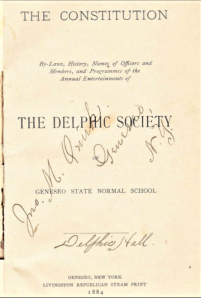
Delphic Society, Geneseo, NY.
After a great deal of collaborative work with researchers, we could finally trace the origin of the Delphic Fraternity to the Delphic Society founded on October 13, 1871, at SUNY Geneseo. This is the official founding date of the Delphic Fraternity, also known today as Delphic of Gamma Sigma Tau Fraternity.
Research shows the fraternity was founded as a college literary society, which was a local student organization. However, historical notes stated the genesis of the literary society at Geneseo stemmed from elsewhere. Fraternity history notes prior literary societal connections yet does not outright mention any names of actual associations or the specific locations of these other societies.
Though the Delphic Society was founded in 1871 at the Geneseo State Normal School (today SUNY Geneseo,) the college literary society later became known as the Delphic Fraternity once it began affiliating with other literary societies in the state of New York and Pennsylvania.
In the 1950s, the Delphic Fraternity at the College at New Paltz (today SUNY New Paltz) briefly became a member of the national organization of Sigma Tau Gamma. In 1962, the New Paltz chapter of Delphic became an incorporated membership entity in the State of New York. In 1987, the New Paltz chapter was re-established as Delphic of Gamma Sigma Tau Fraternity, the first official multicultural fraternity formed on the East Coast of the USA.
The Delphic Fraternity has gone through various formations since its founding in 1871, however, recent findings can connect the creation of the fraternity to college literary societies elsewhere in New York.
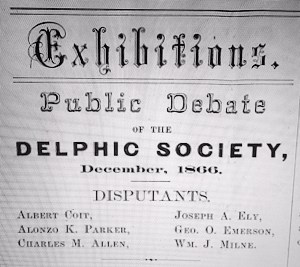
Delphic Society at the University of Rochester
A few years ago, our fraternity was able to finally connect the histories of the Delphic Society at the University of Rochester with the Delphic Society founded at the Geneseo State Normal School. Both were founded as the Delphic Society and the organizations are connected by Dr. William J. Milne.
Milne attended the University of Rochester as an undergraduate and participated in the last public debates sponsored by the Delphic Society in 1866. Milne later became a professor at the Brockport Normal School, and then principal of the Geneseo Normal School in 1871.
Principal Milne was instrumental in the founding of the Delphic Society at Geneseo. Milne wanted to provide students at Geneseo with a college literary societal experience similar to the one he enjoyed while at Rochester. He assisted the 13 Delphic Founders at Geneseo in forming their society and most likely helped name it based on the society at Rochester, which was only 30 miles away.
The societies at the University of Rochester ceased to exist around the late 1860s when the fraternities at Rochester became more prominent and the national affiliation of these organizations outweighed the advantages of local college literary societies.
Once we were able to confirm the historic connection of our fraternity, then known as the Delphic Society at Geneseo, with the Delphic Society at Rochester, we then wondered where the Delphic Society at Rochester came from?
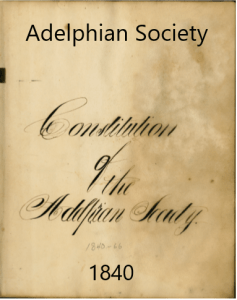
The Adelphian Society was founded in 1840 at Colgate University.
Further research at the library archives at the University of Rochester found that the Delphic Society at Rochester was founded on November 2, 1850. The University of Rochester was formed by students and staff from Madison University in Hamilton, NY (today Colgate University.) Five students from Madison/Colgate who were members of the Adelphian Society transferred to the University of Rochester and founded the Delphic Society.
Therefore, the Delphic Society at the University of Rochester is a lineal descendant of the Adelphian Society at Colgate University. The Adelphian Society was formed in 1840 at the Hamilton Literary & Theological Institution, the initial name of Colgate University.
The Adelphian Society was founded by 31 young men and existed on the Colgate campus in name until 1880 when the society became a chapter of the national Beta Theta Pi Fraternity.
Going back a bit further into the university archives at Colgate, we find that the Adelphian Society originated as another society known as Gamma Phi, the first college literary society to be founded at Colgate University.
Gamma Phi Society, Colgate University
Administrators at Colgate stepped in to help resolve membership conflicts between the Gamma Phi and Pi Delta Societies, the two literary societies at the time. Competition for membership became so fierce that administrators decided to merge the two societies into two new student organizations: the Adelphian and Aeonian Societies.
Colgate University records show that the Gamma Phi Society was founded before 1833 and the Pi Delta Society was founded around 1834. Since no actual founding date is available for the Gamma Phi Society, 1833 is used to reference the year of origin.
The last update to the Delphic Fraternity History e-Book only mentioned the fraternity’s historic ties to the Delphic Society at Rochester. The next update, scheduled for the summer of 2021, will note the organization’s historic connection to the Gamma Phi and Adelphian Societies at Colgate University.
Some may say all these historic affiliations are confusing, and that we as the Delphic Fraternity should just focus on the present organization’s 1871 founding in Geneseo, NY. However, history is what it was. I believe it is vital to truly know one’s organization for we can only fully move forward by acknowledging and learning from our complete past.
It is important to highlight the seminal concept of the fraternity, which after years of research stems from the initial formation of the Gamma Phi Society at Colgate University, sometime around 1833.
All of this history illustrates the fraternal Delphic DNA can be traced back to 1833 via college literary societies even though the actual fraternity as we know it today was founded in 1871.
In any event, I, as the historian of the Delphic Fraternity, have two years to put all my final research together into the 150th Anniversary commemoration of the Delphic Fraternity History e-Book.
Who knows what else can be uncovered before the next update? I am open to suggestions from other fraternity/sorority historians (and those just interested) on how to lay out all this new fraternity history.
Feel free to contact me with any feedback you think may be helpful. Since I am mentioning other organizations in this blog post, please also free feel to message me with any historical corrections or clarifications.
Thanks to LinkedIn, I recently became the social media / marketing manager for Off The Wall Frozen Yogurt. In the last month, I have learned a great deal about the frozen yogurt industry. If you live or work in New York City, you may have noticed all the frozen yogurt shops popping up. At first glance, you would think they are all the same. However, as you take a closer look, you will see and taste that the actual product and service runs the gamut.
Some frozen yogurt has more of a tart taste, others are more on the sweeter side. Some are self serve, others serve the customer. Some spaces are tiny, and others spectacularly spacious. The two main factors for any business are the product and the service. At Off The Wall, you get both at a very high caliber.
To be honest, I’ve never really been a huge fan of yogurt. I recently started eating it for its health benefits. I would pass by frozen yogurt places all the time, not really noticing them. Of course now, I notice them everywhere.
While interviewing for Off The Wall, I tried the product and instantly became a fan. Even if I did not get the job, I would have returned as a customer. The product was incredibly delicious and the staff was extremely friendly and helpful. Off the Wall is much more then incredible frozen yogurt. It’s an awesome experience.
Off The Wall Frozen Yogurt is a self-serve, New York-based frozen yogurt chain founded in 2010. The company presently owns and operates a store in Cedarhurst, NY and three (soon to be four) stores in the borough of Manhattan. Off the Wall’s mission is to curate a playful customer experience from start to finish.
If you’re a frozen yogurt fan, and even if you’re not, you have to give Off The Wall a try. You’ll truly enjoy the frozen yogurt and the experience.
If you have already given it a try, let me know what you think. I’d love to hear from you.





 VelezComm