Posted in Communication, Nursing

Nurses Wanted: Make a Difference at Anchorage Rehabilitation and Wellness Center in Salisbury, Maryland

Nurses are in high demand. But the right nursing opportunity is about more than finding an open position. It’s about finding a place where your knowledge, compassion, and dedication truly make a difference.

Anchorage Rehabilitation and Wellness Center in Salisbury, Maryland, is seeking Registered Nurses (RNs) and Licensed Practical Nurses (LPNs) to join its team for 12-hour shifts.

If you are a nurse who believes that caring for others is more than a profession, if you believe every resident deserves dignity, compassion, patience, and respect, Anchorage wants to hear from you.

Nursing Is More Than What Happens During Your Shift

Every nurse has experienced those moments that remind them why they chose nursing in the first place. Sometimes it happens when a patient takes an important step toward recovery. Sometimes it is the gratitude of a family member. Sometimes it is simply knowing that you were there for someone during one of the most difficult moments of their life.

At Anchorage Rehabilitation and Wellness Center, those moments happen every day.
Residents are not simply names on a census or patients passing through a healthcare system. They are individuals with families, histories, personalities, accomplishments, memories, and stories of their own. Some are recovering from an illness, injury, or hospitalization and are working toward returning home. Others require ongoing skilled nursing care and support. Regardless of why they are at the facility, each resident deserves to be treated as a person first.

That is where you come in.

As a member of the nursing team at Anchorage, you have the opportunity to do much more than administer medications, complete assessments, document care, and follow treatment plans. You have the opportunity to get to know the people entrusted to your care. You may become the familiar face a resident looks for when they wake up in the morning. You may be the person who notices a subtle change in someone’s condition before anyone else does. You may be the voice that reassures a concerned family member or the encouragement that helps a resident keep working toward a rehabilitation goal.

These moments may not always make the evening news or appear on a résumé, but they are the moments that define nursing.

Your Clinical Skills Matter – So Does Your Heart

Healthcare is becoming increasingly complex, and excellent nursing requires knowledge, clinical judgment, attention to detail, and the ability to make sound decisions when circumstances change. We value those skills because our residents depend upon them.

But great nursing is also about something that cannot be learned entirely from a textbook. It is about compassion.

It is about understanding that the person in front of you may be frightened, frustrated, confused, lonely, or simply having a difficult day. It is about knowing when someone needs medical attention and when they may simply need someone to listen. It is about protecting a resident’s dignity when they are at their most vulnerable and treating every individual with the same respect you would want for someone you love.

That combination of clinical expertise and genuine human connection is what makes nursing such a powerful profession. And it is precisely why Anchorage is looking for nurses who want to bring both.

A Different Kind of Nursing Opportunity

Anchorage is aware that nurses have choices. There is a tremendous demand for qualified nursing professionals throughout the Salisbury metropolitan area and across the Delmarva Peninsula. Hospitals, rehabilitation centers, long-term care communities, home health organizations, physician practices, and other healthcare providers are all looking for talented RNs and LPNs.

So when you consider your next career move, you should ask yourself more than What does this job pay?” or What are the hours?” Ask yourself, “Where can I make the greatest difference?”

At Anchorage Rehabilitation and Wellness Center, 12-hour nursing shifts offer the flexibility to build your work schedule around extended periods away from work while remaining part of a team that plays an essential role in residents’ lives.

More importantly, senior rehabilitation and nursing care allows you to build relationships. Unlike environments where a patient may be in your care for only a few hours, your work here can allow you to become familiar with the people you serve. You can learn their routines and preferences. You can celebrate their progress. You can recognize when something has changed. You can develop the kind of trust that can only come from consistency and genuine human connection.

That relationship can be incredibly rewarding.

The People Anchorage Cares For Need People Like You

There are moments in all of our lives when we need someone else.

For many of the residents at Anchorage, that moment has arrived because of an illness, an injury, a hospitalization, a change in their ability to live independently, or simply the realities of growing older. They may be facing uncertainty about what comes next. Their families may be worried. And for a period of time, the nursing team becomes an important part of their lives.

The work can be challenging. Nursing always is. There will be busy shifts, unexpected situations, difficult conversations, and days when you go home knowing you gave everything you had. But there will also be moments that stay with you.

A resident who finally takes those first steps after rehabilitation. A family member who thanks you for taking such good care of their loved one. A smile from someone who has been having a difficult day. The satisfaction of recognizing a change in condition and knowing your clinical judgment made a difference.

Those are the moments that remind us that nursing is not simply a career. It is a calling to care for people when they need us most.

Your Next Chapter Could Begin at Anchorage

If you are an RN or LPN in the Salisbury, Maryland area, take a closer look at Anchorage Rehabilitation and Wellness Center.

Perhaps you are an experienced nurse looking for a new environment. Perhaps you are ready for a change from your current healthcare setting. Perhaps you are looking for a team where your experience is valued and where the work you do every day has a visible impact on the lives of the people you serve.

Whatever brings you to your next opportunity, consider Anchorage.

Come bring your clinical knowledge. Bring your experience. Bring your compassion. Bring your sense of humor, your patience, your dedication, and your desire to make a difference.

Most importantly, bring the reason you became a nurse in the first place. Because somewhere in our community is a resident who needs what you have to give.

Join the Anchorage team.
Posted in Communication, Community Service

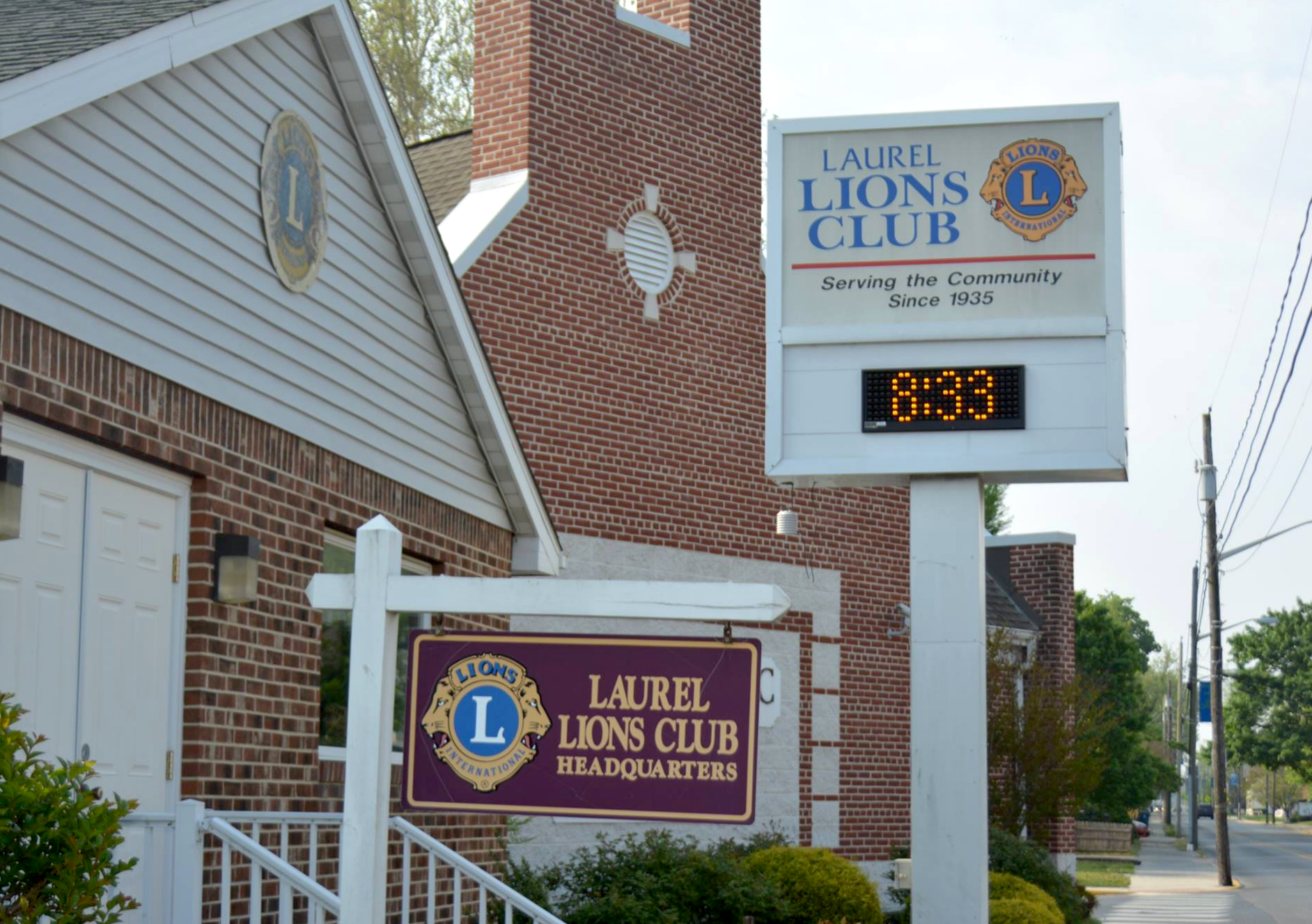
Laurel Lions Club of Delaware

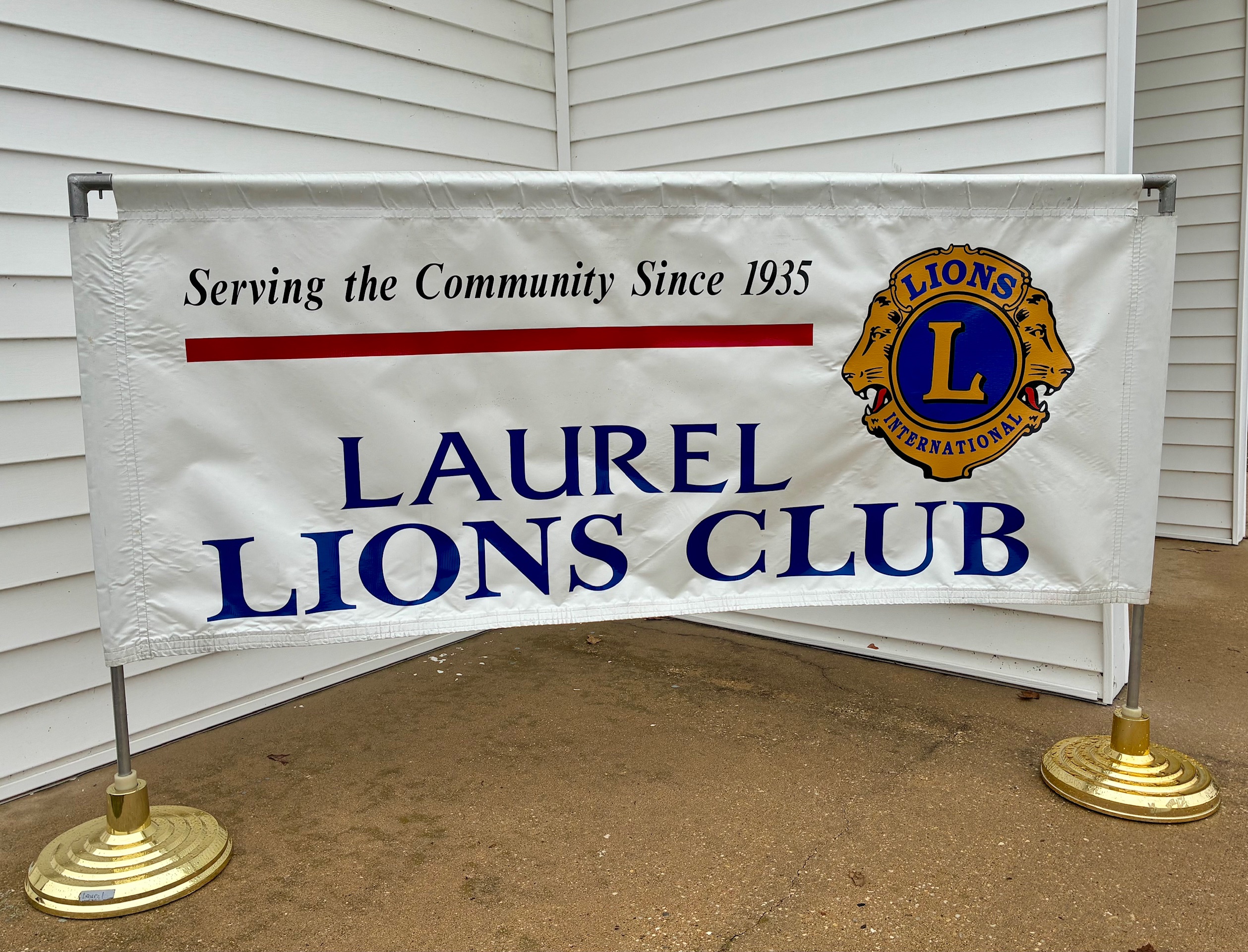
On September 11, 2025, I became a member of the Laurel Lions Club in Laurel, Delaware. I had recently relocated to Delaware from NYC and wanted to be part of a community group that had a long history in Laurel. The club provides me with an opportunity to get involved with charitable events and projects and meet like-minded people. The Laurel DE Lions Club has been serving the community since its formation in 1935. It is part of the Lions Club International Multiple District 22, which encompasses Delaware, Maryland, and Washington, D.C. The Laurel DE Lions Club in District 22-D was formed on November 29, 1935.

This local club is connected to the global Lions Clubs International, the largest service club organization in the world, with more than 1.4 million members in over 48,000 clubs serving in 200 countries. Since 1917, Lions have strengthened local communities through hands-on service and humanitarian projects. We are focused on supporting vision, the environment, childhood cancer, hunger, diabetes, and other pressing humanitarian needs to help address some of the biggest challenges facing humanity.

My goal is to help promote the history and work of the Laurel DE Lions Club, with the ultimate aim of increasing its membership over time. Does the idea of becoming part of something greater than yourself appeal to you? Do you want to contribute to an organization whose focus is to make the world a better place? If so, then become a Lion.

Here are my top three reasons to join a Lions Club:

Local and Global Impact – Lions Clubs are world-renowned for their dedication to service. When you become a Lion, you’re not just attending meetings; you’re actively involved in projects that make a real difference, both locally and around the world. You’ll help decide where the club’s efforts and funds are needed most in your town, whether it’s collecting glasses, providing scholarships, or supporting a local food pantry. As part of Lions Clubs International, your local efforts contribute to a vast global network that addresses significant humanitarian challenges, including the worldwide fight against preventable blindness.

Develop Leadership Skills and Professional GrowthLions Clubs are excellent training grounds for leadership. Regardless of your current profession or experience, being a Lion gives you practical, hands-on opportunities to lead projects, manage budgets, and organize events. You can volunteer to chair a committee, organize a fundraiser, or serve as a club officer (Treasurer, Secretary, President). You’ll connect with successful, service-minded people from diverse backgrounds in your community, expanding your personal and professional network in a meaningful way.

Gain a Sense of Purpose and Personal Fulfillment – Giving back is scientifically proven to boost happiness and well-being. By dedicating your time and energy to helping those in need, you gain a powerful sense of purpose that extends beyond your daily routine. There is nothing more fulfilling than seeing the direct, positive results of your efforts, like helping a child receive a life-changing eye exam or ensuring a family has food on their table. Your dedication has the power to meaningfully impact the lives of those who need it most.

So are you ready to be a Lion? Contact your local Lions Club today!

The Laurel Lions Clubhouse on 311 S Central Ave., Laurel, DE 19956, United States.
Posted in Communication, Networking

SUNY New Paltz Alumni Network

SUNY New Paltz signage near the Old Main Building – photo by Phil Velez

I am a proud alumnus of the State University of New York at New Paltz, my home away from home for approximately the last 30 years. For the past several, I have been a member of its Alumni Council, which represents over 72,000 alumni across the U.S. and around the world. I love promoting my alma mater whenever possible, however, this is the first time I’m blogging about it.

One of the aims of this post is to encourage my fellow New Paltz graduates, and students who attended the school, to become active within the Alumni Association. The university has created an online platform for the SUNY New Paltz community called the Orange and Blue Network. It’s the best way to stay connected with the amazing institution of higher learning located just 90 minutes from New York City.

Jacobson Faculty Tower at SUNY New Paltz – photo by Phil Velez

The history of the school nestled in the Hudson Valley begins in 1828 with the opening of the New Paltz Classical School. In 1833 it was re-organized as the New Paltz Academy which later became the New Paltz Normal School in 1885 and then the State Teachers College of New Paltz in 1942.

The college at New Paltz joined the State University of New York system in 1959, first being called the College of Education, then the College of Arts and Sciences before its current moniker as a university which it has been using since 1994.

My experience as a student at New Paltz has helped shape the person that I am today. My formative college years prepared me for life providing me a solid academic and social education I cherish to this day.

While an undergraduate, I became a member of the first fraternity at New Paltz which dates back locally to 1889. Becoming a brother of the Delphic Fraternity has historically tied me to SUNY New Paltz. Annual fraternity reunions have been held in the town of New Paltz since the early 1990s and I have only missed a few.

The Old Main Building at SUNY New Paltz – photo by Phil Velez

If you have registered for the Orange and Blue Network, thank you for being a part of the online New Paltz community. If you have not registered yet, I strongly encourage you to do so. The platform allows you to stay connected, share your journeys, and support the next generation of Hawks.

By registering, you’re not just reconnecting with old friends; you’re also becoming part of a dynamic community that continues to thrive and make a difference. Let’s come together, celebrate our shared heritage, and contribute to the ongoing success of SUNY New Paltz. Join us today and be a part of something truly special!

Posted in Communication, fraternity, history, New York, Writing

Delphic Fraternity Historian Begins Work on 150th Anniversary History e-Book

delphic fraternity, delphic society
The Delphic Fraternity was first the Delphic Society.

Since the early 1990s, I have researched the Delphic Fraternity. It was a college literary society based in New York that eventually became a statewide fraternity. The fraternity almost became extinct in the late 1980s, until a small group of diverse male students at the New Paltz State College decided to form a multicultural fraternity.

In their initial fraternity fact-finding mission, the future members of the New Paltz fraternity came across many historical references to the Delphic Fraternity, the first and oldest fraternity in New Paltz. It was last active in 1972 and in 1986 some alumni still lived in the surrounding areas. The fraternity interest group contacted local alumni and in 1987, after a great deal of hard work and determination, the New Paltz student group was initiated into the legendary Delphic Brotherhood.

I joined Delphic of Gamma Sigma Tau Fraternity during my junior year at SUNY New Paltz. I had been fascinated by fraternities and sororities since freshman year. I could see myself in a few of them, but not one stood out for me enough to commit to joining.  Back in the late 1980s, fraternities at New Paltz were either predominantly White or Black organizations.

I did not want to be a part of a specific ethnic fraternity and that included any that were all Latino as well. This group of future Delphics was a multicultural bunch of guys, which I found very interesting mainly for the opportunity to learn about different cultures. Then I noticed the word “Delphic” on some fellow students’ t-shirts and I inquired about what it signified.

I was told the guys, some of which I had known and had already developed friendships with, were working to re-establish the oldest local fraternity at New Paltz. They were also looking to form the first official multicultural fraternity on campus. The combined possibilities piqued my interest. I attended a general interest meeting and as they say, the rest is fraternity history.

I have been active as the fraternity’s self-proclaimed historian for more than 25 years. We have another historian from the 1960s named Rich, but he’s not on the Internet much. Rich manages the actual artifacts of the Delphic Fraternity. I tirelessly work as the organization’s social media manager and assist with the online promotion of the fraternity far and wide. It’s also great to see younger Delphic Brothers interested in and owning our rich fraternity history.

When I graduated from college, I had some time to delve a bit more into the history of the fraternity. Throughout the years and in between jobs, I continued to put the fraternal pieces together. The archives at SUNY New Paltz noted the organization as one of several in the state. I then reached out to other SUNY libraries to begin connecting the Delphic dots.

The Zeta chapter at New Paltz operated as a purely local fraternity at the time. Alumni from the 1960s told me they knew there were other chapters of Delphic and/or Sig Tau in the state, but they did not really know where exactly. Oneonta kept coming up as another location.

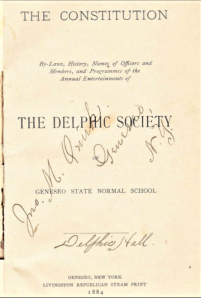
Delphic Society
Delphic Society, Geneseo, NY.

After a great deal of collaborative work with researchers, we could finally trace the origin of the Delphic Fraternity to the Delphic Society founded on October 13, 1871, at SUNY Geneseo. This is the official founding date of the Delphic Fraternity, also known today as Delphic of Gamma Sigma Tau Fraternity.

Research shows the fraternity was founded as a college literary society, which was a local student organization. However, historical notes stated the genesis of the literary society at Geneseo stemmed from elsewhere. Fraternity history notes prior literary societal connections yet does not outright mention any names of actual associations or the specific locations of these other societies.

Though the Delphic Society was founded in 1871 at the Geneseo State Normal School (today SUNY Geneseo,) the college literary society later became known as the Delphic Fraternity once it began affiliating with other literary societies in the state of New York and Pennsylvania.

In the 1950s, the Delphic Fraternity at the College at New Paltz (today SUNY New Paltz) briefly became a member of the national organization of Sigma Tau Gamma. In 1962, the New Paltz chapter of Delphic became an incorporated membership entity in the State of New York. In 1987, the New Paltz chapter was re-established as Delphic of Gamma Sigma Tau Fraternity, the first official multicultural fraternity formed on the East Coast of the USA.

The Delphic Fraternity has gone through various formations since its founding in 1871, however, recent findings can connect the creation of the fraternity to college literary societies elsewhere in New York.

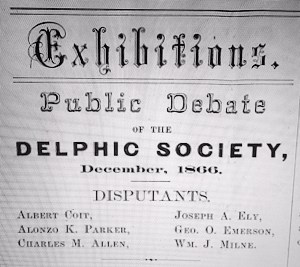
Delphic Society, Rochester
Delphic Society at the University of Rochester

A few years ago, our fraternity was able to finally connect the histories of the Delphic Society at the University of Rochester with the Delphic Society founded at the Geneseo State Normal School. Both were founded as the Delphic Society and the organizations are connected by Dr. William J. Milne.

Milne attended the University of Rochester as an undergraduate and participated in the last public debates sponsored by the Delphic Society in 1866. Milne later became a professor at the Brockport Normal School, and then principal of the Geneseo Normal School in 1871.

Principal Milne was instrumental in the founding of the Delphic Society at Geneseo. Milne wanted to provide students at Geneseo with a college literary societal experience similar to the one he enjoyed while at Rochester. He assisted the 13 Delphic Founders at Geneseo in forming their society and most likely helped name it based on the society at Rochester, which was only 30 miles away.

The societies at the University of Rochester ceased to exist around the late 1860s when the fraternities at Rochester became more prominent and the national affiliation of these organizations outweighed the advantages of local college literary societies.

Once we were able to confirm the historic connection of our fraternity, then known as the Delphic Society at Geneseo, with the Delphic Society at Rochester, we then wondered where the Delphic Society at Rochester came from?

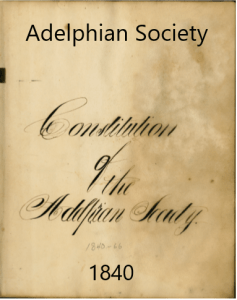
Adelphian Society
The Adelphian Society was founded in 1840 at Colgate University.

Further research at the library archives at the University of Rochester found that the Delphic Society at Rochester was founded on November 2, 1850. The University of Rochester was formed by students and staff from Madison University in Hamilton, NY (today Colgate University.) Five students from Madison/Colgate who were members of the Adelphian Society transferred to the University of Rochester and founded the Delphic Society.

Therefore, the Delphic Society at the University of Rochester is a lineal descendant of the Adelphian Society at Colgate University. The Adelphian Society was formed in 1840 at the Hamilton Literary & Theological Institution, the initial name of Colgate University.

The Adelphian Society was founded by 31 young men and existed on the Colgate campus in name until 1880 when the society became a chapter of the national Beta Theta Pi Fraternity.

Going back a bit further into the university archives at Colgate, we find that the Adelphian Society originated as another society known as Gamma Phi, the first college literary society to be founded at Colgate University.

Gamma Phi Society
Gamma Phi Society, Colgate University

Administrators at Colgate stepped in to help resolve membership conflicts between the Gamma Phi and Pi Delta Societies, the two literary societies at the time.  Competition for membership became so fierce that administrators decided to merge the two societies into two new student organizations: the Adelphian and Aeonian Societies.

Colgate University records show that the Gamma Phi Society was founded before 1833 and the Pi Delta Society was founded around 1834. Since no actual founding date is available for the Gamma Phi Society, 1833 is used to reference the year of origin.

The last update to the Delphic Fraternity History e-Book only mentioned the fraternity’s historic ties to the Delphic Society at Rochester. The next update, scheduled for the summer of 2021, will note the organization’s historic connection to the Gamma Phi and Adelphian Societies at Colgate University.

Some may say all these historic affiliations are confusing, and that we as the Delphic Fraternity should just focus on the present organization’s 1871 founding in Geneseo, NY. However, history is what it was. I believe it is vital to truly know one’s organization for we can only fully move forward by acknowledging and learning from our complete past.

It is important to highlight the seminal concept of the fraternity, which after years of research stems from the initial formation of the Gamma Phi Society at Colgate University, sometime around 1833.

All of this history illustrates the fraternal Delphic DNA can be traced back to 1833 via college literary societies even though the actual fraternity as we know it today was founded in 1871.

Delphic_Seal

In any event, I, as the historian of the Delphic Fraternity, have two years to put all my final research together into the 150th Anniversary commemoration of the Delphic Fraternity History e-Book.

Who knows what else can be uncovered before the next update? I am open to suggestions from other fraternity/sorority historians (and those just interested) on how to lay out all this new fraternity history.

Feel free to contact me with any feedback you think may be helpful. Since I am mentioning other organizations in this blog post, please also free feel to message me with any historical corrections or clarifications.

Posted in Communication, Politics

Political Communication – 2018 Mid-term Elections – Words Matter

Words MatterWe have a leader of the United States that creates his own stories. He makes up facts and wants others to believe in these falsehoods. But the truth is what it is, as is history.  America has had two years of Trump and his dedicated supporters trying to destroy this country with hate and division. This Tuesday night we will learn a great deal about the USA. We will learn if this adversarial political atmosphere will fester for two more years, or we’ll begin to see a glimmer of national unity.

Political communication matters. Politicians need to make it clear what they stand for and who they represent. People who enter the political arena should do so to truly make the country a better place. Political leaders need to be clear about what policies and changes they will fight for and what issues they will fight against. Voters need to be involved because now more than ever, politics matter. Politicians need to be precise with their principles and communicate them clearly because words matter. Americans must get out and vote this Tuesday to have our voices heard because our future matters. Don’t be a dope. #vote